
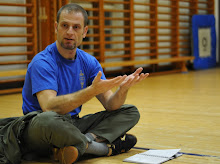
Whenever an opportunity to train with Alex Kostic turns up, I do my best to grasp it and you know what? - it's not just because I want to train with him. Please don't misunderstand me, Alex's seminars are full of insights and those "aha!" moments, regarding their technical content. What I find even more fascinating though, is talking to him, because he has this uncanny ability to draw analogies between philosophy and somatic psychotherapy (his fields of academic study) and martial arts training and practice. During the last two times we met and trained with Alex (November 2009 in Sweden and two weeks ago in Athens, Greece), we discussed extensively his personal approach to Russian Martial Art, which he has named "Sistema Homo Ludens" and honestly, a number of his ideas made a huge impression on me. For those of you who do not already know, "Homo Ludens" (Man the Player) is a book written in 1938 by Dutch historian, cultural theorist and professor Johan Huizinga, that discusses the importance of the play element of culture and society. My personal views on an approach of teaching combat skills (or any other type of skills) through play might be the subject of a future blog post. What I wanted to share in this post is a text posted by Alex himself yesterday of Facebook, regarding the philosophy of Sistema Homo Ludens, plus a video trailer highlighting the various aspects of Homo Ludens training and a video interview of Alex explaining more of his ideas. Hope you enjoy these!
"Homo Ludens: Philosophy (by Alex Kostic)
Combat, as a diverse conglomeration of specific practices of relations with oneself and others, necessarily implies movement as a horizon of more or less set possibilities. For each of us, the possibility of movement is so axiomatic and immediate that we almost never think of it. The moves that people make are most often instrumental in character – walking from part of the town to another in order to get to work, bending over to reach an important document in a drawer, sitting down to get rest, etc. The common thread for all these motions is that they are not an end in themselves, but rather aimed at some purpose exterior to the movement itself. On the other side, in the window of glorious human dignified practices are those that have taken movement to an art: acting, ballet, dance, etc. What does it mean? It is to say that within those practices the movement is not in the function of some immediate goal, but instead it rises to the fullness of its temporality, which realized its essential capacities through the play. Play, therefore, is not something we use to attain any other goal – it is a goal in itself.
The common attitude is that in combat training most important issue is the command of various fighting techniques. Nevertheless, in the course of such training, what is referred to as techniques, and meant to be the desired outcome of a movement, is usually simply “glued” to a body that tries, under the pressure of desire for success, to anticipate the unpredictable spontaneity of the situation, in which only a body educated through movement can lead to more or less favorable resolving of the conflict. The technical training attempts to compensate for what is lacking in the domain of corporal education, by reaching for the satisfactory outcome in a strictly controlled situation. That way, the combative training instills in its practitioners the uncritical self-confidence in an irresponsible manner, the self-confidence that is not founded in the freedom of move, but rather in the fantasy of efficiency.
First one needs to suspend the yearning for the perfection of technique, for the sake of free movement. Such freedom does not bear with dogma or school uniformity, but instead seeks space for play, which in a conflict situation becomes the unpredictable struggle for survival. Therefore, a man who plays will not ask about the origins of the particular movement, but alternatively he will reinvent every “technique” himself.
That way, the first step in educating the body entails linking the movements freely into various biomechanical kinetic chains. At first on one’s own and later with a partner, the body learns to anticipate force vectors and in the beginning starts with imitation, but soon follows with improvisation, in order to relieve itself from striving to do the “right” or “realistic” technique. In its place, it will make the necessary and sufficient movement, thus rewarding the practitioner with satisfaction. In that context, the satisfaction lures the body into breaking out of its shy autism and stepping into the field of its possibilities. However, in that field there is someone else waiting, and with regards to combat, that someone is threatening.
The threat at hand simulates the feeling of being in danger, which cannot be escaped through any training. In the first stage, the subject has acquired fluid movement, softening the body with pleasure and forgetting about the threat. Once it matures, the body needs to be scared by strong hits, impossible situation that humiliate the narcissism of theatrical flawlessness.
The threat at issue simulates the feeling of danger that cannot be avoided through any training. In the first phase, the subject has acquired fluidity of movement, softened his body with pleasure and forgot about the threat. Once the body has matured, it needs to be scared by powerful strikes and “impossible” situations, which humiliate the narcissism of the theatrical flawlessness. Only through perseverance in the experience of stressful contact it is possible to talk about mature, self-critical attitude towards conflicts. Once the spontaneity of movement, which does not stem from the conscious projection characteristic for technical exercises, is unified with the experience of the struggle and overcoming obstacles, the training becomes free play that is no longer played by the child in its naïveté, nor the adolescent in its competitiveness, but rather an adult person in its responsible relaxation.
Let the spirit of play spread through the training hall, and not the dubious authority of a master, who compensates his fear from the loss of control through egotistical perfectionism. Let the gym become a temporal and unpretentious community of equal explorers of corporal movement, instead of a bullying domain, which insists on rivalry, thus establishing the ungrounded hierarchy that, as a rule, only results in selfish egotism".
More on Alex Kostic and Sistema Homo Ludens at www.russianmartialart-serbia.com.
You can preview the book Homo Ludens by Johan Huizinga here.
Sunday, 21 February 2010


Thursday, 28 January 2010
What would you rather play? The guitar or Guitar Hero?
 Strangely enough, even though I grew up listening to and idolizing the great heroes of guitar (Jimi Hendrix, Jimmy Page, Richie Blackmore, Jeff Beck, but also B.B. King, Albert King, Steve Cropper, Wes Montgomery, Kenny Burrell and George Benson, among others), the people who designed and market the video game Guitar Hero, probably do not consider me (and most people of my generation) as part of their target group. Besides listening to famous guitar players, I also took up playing the guitar for a few years when I was younger. But since I also trained in martial arts, I decided that you cannot break bricks, boards and tiles and at the same time demand from your fingers to be agile, so I finally ended up just playing air guitar at parties...
A few months ago I played Guitar Hero for the first time and although, based on my past, one would expect me to enjoy it, well... I didn't. Part of my dislike for the game comes from the fact that I'm rather the old-school type. I admire all guitar heroes, because they spent countless hours practicing before they managed to reach fame and stardom: first they got to know their "axes" as good as possible and perfected their "licks", then practiced with a band, then performed at humble establishments (to say the least) in order to get their act solid – in a few words they paid their dues. Nowadays, it seems that anyone can "live the experience" of being a guitar god, with the help of a piece of electronic equipment and none of the fuss – so typical of the age of instant gratification we live in. I’m afraid I just don't get it...
Of course some of you might say that this is an ethical reason
 to dislike the game, but the ethics of one person do not necessarily coincide with those of another, and I am not going to argue on that. Still, there are a few more reasons I do not like Guitar Hero, rather of a practical nature, and I would like to present them too, so here I go:
1. The game is not that much of a challenge. Sure, it requires some skill, but not much: some sense of rhythm and hand-eye coordination. A recreational guitar player definitely has those and something more: he knows how to produce tones from the instrument he's holding.
2. There's not enough freedom. With only five buttons (!) on the fretboard plus a lever that simulates the picking of the strings, there are only twenty or so (correct me if I'm wrong) combinations of things you can do with your fingers of both hands. The combination to use each moment is provided by the game software – you are not allowed to deviate from the "correct" choice, which is dictated by the original recording of the song included in the game disc. So basically, you don't play the game, the game plays you. Isn't this very un-guitar hero? Can you imagine Jimi Hendrix playing the exact same solo every time he played a specific piece of music? Yeah, I thought so… Plus, you cannot regulate the sound of your guitar by using your wah-wah pedal, by playing with a slide, by bending, plucking, strumming the strings or whatever. Boring…
3. It simply doesn't get you anywhere! After having "played to perfection" all the songs included in one of the game discs (possible, but not probable, since the compilations are rather uneven), the fun is over until you buy another disc. Whereas, a guitar allows you to learn new songs every now and then so you can have fun with your friends, become a virtuoso soloist, or even compose your own music – as long as you put the time and effort.
4. A guitar player can very easily play Guitar Hero. A Guitar Hero player can't necessarily play the guitar. Do I have to elaborate on that one?
Lately, a number of people with some experience in military Close Quarters Combat systems have contacted me in order to start training in Russian Martial Art. Some of them seem to think that RMA is a typical CQC system, only the "techniques" we use are more effective, due to the (partially) Soviet origins of our training method. I try to explain that in RMA, we treat every action (a sequence of movements with a specific goal) as a "symphony of movement". And in order to reach the level of skill needed to perform a symphony, one must first learn how to play scales of single notes, i.e. explore the movement potential of the human body for its own sake, then play some "musical phrases" with these notes, later start interacting with other "musicians" in order to understand the ideas of harmony and counterpoint, and finally perform the part which is needed in any given musical piece. The end goal of this process is what my friend and senior Systema RMA instructor Emmanuel Manolakakis calls "a set of skills for life", not only for combat or survival.
The analogy I use between Russian Martial Art and music seems to put off the people who are interested in "a few high percentage techniques" that will address most situations, so they never show up for training. And I think that's for the better, because as an instructor and coach, I'd rather teach people how to play the guitar than play Guitar Hero...
Saturday, 5 December 2009
You think you're ready to train in martial arts? Well, think again!
 I vaguely remember this warm afternoon back in the late nineties. My Kung Fu instructor had taken all his students to the local track, in order to do a Cooper test. I was in the first bunch of students to complete their 12 minutes of running, and I was standing aside and recovering while the second group performed the test. Maria was running with the second group - she was in her early thirties, and I guess she thought that training in Kung Fu fitted well with her alternative, slightly new-agey lifestyle. I remember she had a sunny disposition and was almost always smiling, but as she was walking towards the rest of us after the end of the test, all I could see in her face was discomfort and frustration.
"Hey, what's with you?", I asked her as she was approaching.
"Well, you know what?", she replied. "I never had the slightest pain in my body... until I started training".
I didn't pay much attention to what she said, I just found it rather funny - I mean, who would take up any kind of training in order to accumulate pain in their body? Still, as my Kung Fu years went by and both the volume and the intensity of my training escalated, as I gradually shifted my focus towards san shou competition, something strange started happening to my body. In the very beginning it was dull pain in both my knees, which was dismissed as "adaptation discomfort", and went away after a few sessions of acupuncture. Later, I started feeling some generalized soreness in my whole body after intense san shou sessions, and it did not go away until my warm-up for the next training session. At some point, I had to take almost a month off training because of a sharp pain in my right shoulder (which later developed into a nasty supraspinatus tendonitis that bothers me until today). The next body part to give way was my lower back: two, maybe three times a year, the muscles in my left lower back went into spasm, and I had to stay away from both training and my job for days at a time. In late 1999, while preparing for the 5th World Wushu Championships, I trained six hours a day, six days a week and at the same time, devoted a minimum of eight hours a day to my job. My body was constantly complaining and I had trouble sleeping at night due to numerous pains. I talked to my instructor about this and his reply was that "my problem was fear, not injury" (or something just as stupid and ignorant), so I kept on training - I wasn't going to cave in to fear, right? Of course, in order to keep going, I had to take lots of pain killers and muscle relaxants. In the end, I was unable to peak my training for the championships, but I travelled to Hong Kong anyway and lost in my first bout. Six months later, in the Wushu nationals, I managed to win two fights, but in the third one, for the gold medal, I had to quit after two rounds. It was impossible to continue fighting, because I could barely stand upright - the pain in my lower back was excruciating and my left leg was numb from the buttock down to the toes. A few weeks later, an MRI scan revealed a L5-S1 hernia and degeneration of disk in my spine. Although my doctor (an orthopedic surgeon) told me that I would never be able to train again unless I had the hernia surgically removed, I ignored him and managed to make a come-back after three weeks of rest, another few sessions of acupuncture and some dead-lifting (no, seriously). A year later, I partially tore the meniscus in my right knee, and as I was pretty close to the age of 35 (which is the age limit for the International Wushu Federation san shou competitions), I decided to call it quits - something which gradually led me away from the Chinese martial arts altogether.

While it is relatively easy to describe the injuries, it is hardly possible to convey through writing all the pain, the frustration and the anguish I felt back then. After all, I was supposed to be a talented athlete! Why was this happening to me? Well, the thing is that my body was trying to tell me something by breaking down, and I was just not listening. In the next years (as I grew older and, presumably, wiser) I decided to pay more attention to what my body was trying to tell, and I also tired to learn as much about the human body as I could. So, what I know today and did not back then, is that I started my training for san shou competition being slightly scoliotic towards the right side, so my right shoulder was slightly protracted and internally rotated (does this spell supraspinatus tendonitis, or what?). I was also slightly knock-kneed, and my feet were slightly everted in a normal standing position. I emphasize that all these problems were slight. They could not be detected, if one did not know what to look for, and it seems no one did. The orthopedic surgeon I mentioned above later told me that they were all deviations from the ideal, but still, well within what is considered to be normal. Oh, and one more thing: my squatting technique was very bad, but nobody seemed to know what to do about it. In any case, it seems that there was no particular reason (at least in the beginning) to suspect problems in my motor control, since I could easily perform all the skills related to my sport.
I suspect that the wealth of information widely available today on the structure and function of the human body was not available back then - certainly not in a country like Greece anyway. The thing is that all those slight asymmetries in my body were weak links leading to what sports scientists refer to as "energy leaks" due to poor biomechanics. You see, even if an athlete has some sort of deficit in strength, flexibility, coordination, stability or balance (like I did), the body will unconsciously find a way to perform what is asked of it, even if that way is less than technically optimal. This is known as "compensating" and that's exactly what causes an energy leak to happen. According to physical therapist and strength training expert Gray Cook, "an energy leak occurs when all of the energy generated to perform a certain task or movement, does not go specifically into that task or movement. Science tells us that the energy must go somewhere. Usually the energy creates stress within the body. The stress can take many forms. It may cause unnecessary work or movement in another part of the body, placing greater stress on certain muscles and tendons (strains). It may create unnatural motion of the spine or limbs, placing greater stress on joints and ligaments (sprains). This movement can create stress and trauma that may go unnoticed for weeks and months. Eventually the athlete will pay the price if the stress continues [mybold]" [1]. Keep in mind that we are talking about slight mistakes here that initially do not affect performance and usually cannot be detected by someone who does not know what to look for. So as the training load increases, a shoulder starts to hurt more and more, the lower back is consistently sore, a knee buckles, but the causes remain mysteriously unknown!
When one takes up martial arts training, it is taken for granted that his body is functioning properly and ready to accept the training load imposed by the needs of the art. Well, this might have been the case with young boys in ancient Sparta, the offspring of the samurai in feudal Japan, and the children in a Cossack tribe. Is it the same though with modern Western people (even youngsters) who grow up sitting for hours at a time in front of a computer, and who's idea of exercise is playing video game hockey or basketball? I very much doubt it. The body needs to be thoroughly tested and assessed first in order to determine if generic movement properties are correct, before one proceeds to learning martial art (or sport) specific movements. After all, a two arm shoulder throw (morote seoinage for you judo people) is nothing but a push and a pull, a rotation around the body's central longitudinal axis, a squat and a bend at the hips. Still, if there is even a minor problem in any of the movement components, the thousants of repetitions required in order to master the technique, will inevitably lead to injury. Oh, and one more thing: even elite level athletes use compensatory movement patterns, resulting in overuse injuries or training plateaus. Imagine what might be the case with an average 20 year old who walks into an MMA school with dreams of becoming "the ultimate fighter"...
So how is it then that one can assess generic movement properties, before progressing to specific skills? Well, there are numerous methods out there, and it is the responsibility (and dare I say, duty) of every coach, especially those working with children, to study as many of these as possible. Otherwise, some day a student might walk up to his Sensei, Sifu, Guro or Coach, and say: "You know what? I never had any pain in my body... until I started training". And that wouldn't be nice, would it?
References:
[1] Cook, G. Athletic Body in Balance. Human Kinetics, 2003. p. 9
Thursday, 12 November 2009
So, what's so special about this Fedor guy anyway???
My good friend Vadim Kolganov, SAMBO Master of Sport, once told me that a lot of people have recently taken up SAMBO training, because they believe that this way, they'll discover Fedor Emelianenko's secrets. "But to be honest with you", Vadim continued, "Fedor is not SAMBO. Fedor is just...Fedor!" And what exactly might that be, then? Another friend, Coach Greg Mihovich, muay thai fighter and high level judo competitor, wrote on Facebook the other day that Fedor is "a tremendous combination of skill, power, mental strength, dedication, will, heart, spirituality and humility". I believe that Greg sums it up pretty well on what makes Fedor a great fighter and moreover, a great champion (if I'm allowed to say, a champion at the same level with mythical figures of the 20th century, like Mohamed Ali or Michael Jordan).
Still, in my mind the question remains: what is it that makes Fedor so much better than his opponents? Can it be the "style" he's practicing? Well, according to many hardcore MMA fans, who zealously share their opinions in various internet forums, he practices SAMBO and boxing, which is basically what every other MMA fighter on the planet is practicing - a grappling style combined with a striking style. Could it be that he's developed a set of more effective techniques? Mmm, those techniques have been revealed in the book "Fedor: The Fighting System of the World's Undisputed King of MMA", (widely) available by Victory Belt publications. Unless nobody on this planet bought the book, there should be a number of fighters out there who know the techniques by now. Why haven't they been turned into wrecking machines? OK then, is it possible that Fedor trains more and harder than his opponents? I very much doubt that: in this, world-class level of competition, I don't believe there's enough time in a 24-hour day to put more training in. How about his mental attributes and his sheer toughness? To be honest, I do not know enough about his mental attributes in order to judge, so maybe. Regarding his toughness, I'd say there's no tougher fighter out there than Minotauro Nogueira and even he, got soundly beaten by Fedor, not once but twice!
It's pretty hard reaching a conclusive answer, so here's what I thought: why not watch Fedor's last fight against Bret Rodgers, and try to pinpoint a few things that Fedor does obviously differently than his opponent? Because - you never know - a secret might be hidden in plain sight, right? So, here's the fight and right after, what I notice:
First, check and compare the two fighters' postures. It seems to me that Fedor keeps an upright, relaxed posture, with his shoulders kept naturally down, and his weight evenly distributed over both his feet, while Rogers fights from a semi-crouch, weight forward, spine slightly flexed, shoulders slightly elevated and internally rotated. Is it possible that the forward flexion of the torso does not allow for efficient rotation around the spinal axis, reducing the force of his strikes? Could it be that the elevation of the shoulders (through the use of the upper trapezius and levator scapulae muscles) directs forces to the cervical (the neck, that is) and the upper thoracic spine, towards structures who provide less support and stability, resulting, once again, in diminished power generation? Of course, I will not claim that Rogers is not a hard hitter, but inefficient biomechanics leads to waste of energy: with diminished structural stability, one tends to use pure muscular strength instead, and that leads to fatigue. Well, don't you think Rogers "gassed" relatively early for a world-class athlete? Oh, and one more thing: both spinal flexion and shoulder elevation can mess with an athlete's breathing patterns and guess where that leads: yep, fatigue it is! So, according to elementary sports biomechanics, the foundation for efficient movement is posture[1], still there's a number of MMA coaches out there teaching the "hunchback" as the best fighting stance. Go figure...
At the exchange starting at 1.34 of the video, ending with Rogers being taken down, and once again at 3.01-3.10, notice how Fedor seemingly overextends with his leading right punch, but his feet follow up immediately so that his center of gravity always ends up above his base of support. This way, he maintains stability through mobility so he’s able to continuously generate power from any position. He probably breaks every rule in the textbook of boxing by abandoning his fighting stance and squaring up to his opponent, but guess what: it does not really matter, because he gets the job done by not being bound by his fighting stance! This is a perfect example of what is known as agility and dynamic balance, two fundamental athletic attributes whose application is not limited to fighting. And these attributes are trainable, as every self-respecting football, basketball or tennis coach will tell you.
What else do I see in Fedor that I don’t see in Rogers? I see beauty of movement and effortlessness, and these mean nothing else but technical perfection. To achieve this lever of mastery, according to Joanne Elphinston, performance consultant to elite professional athletes, one requires “a physical structure that supports the sport’s biomechanics, the neuromuscular coordination to correctly sequence the movement, the psychological skills to focus effort without unnecessary tension and the physiology to sustain the movement pattern until the event is completed”[2]. What I’m trying to say here is that while Brett Rogers (and the majority of MMA fighters out there today) is a tough fighter, period, Fedor is a fantastic athlete, which makes him a-totally-different-class-of-a-fighter. The thing is that the “generic” attributes and skills that make a great athlete can and should be trained before one proceeds to train the specific skills of a sport. I have no specific information about how Fedor acquired those, but seeing that athletes from the former Soviet Union are demonstrating technical mastery more consistently, I can only assume that he has benefited from the advanced research done during the Soviet era in the fields of human movement, sports, and performance enhancement, which was later incorporated in the physical education system of the former USSR. On the other side, your Joe Average MMA fighter, begins as a young man, brimming with testosterone and a vague notion of toughness in his head, who goes to an “MMA Academy” and starts technical training from day one, hitting bags, pads and sparring partners, according to the methods of the so-called “old school” (OK, he also does some roadwork and maybe lifts some weights). Well, I have once heard someone say that there’s no better way of guaranteeing an average fighter than to train him in an average way (don’t remember who it was, so I cannot quote him, sorry ‘bout that) and I tend to agree with that.
One last thing that I notice in Fedor, which I actually haven’t yet seen in any other MMA fighter out there, no matter how highly ranked, is adaptability and flow. Fedor is not trying to apply his SAMBO techniques, he is not “integrating his striking with his grappling” and he is not trying to impose a specific system’s fighting strategy – he just does what he has to do in order to break his opponent down. What do I mean by that? Take, for example, Minatauro Nogueira: as excellent a fighter he might be, in each and every one of his fights, he follows the exact same, typical of BJJ, strategy; shoot to take down, try for submission. In his fights against Cro Cop and Tim Sylvia, he just kept on trying to take them down unsuccessfully, until he managed to pull through, on the way taking quite a beating and surviving thanks to pure guts. Take away his BJJ strategy and he’s most probably in trouble. Why? Because he is defined by the style (art, system, sport, whatever…) he practices. Fedor, although he practices SAMBO, is not defined or limited by it. Check again the two exchanges from the Rogers fight I mentioned above, both ending with Fedor taking his opponent down: he leads with the right hand, seemingly loses his balance, steps deeply inside with his right foot and hooks with the left hand. Only, since he’s now in close distance, the second strike becomes a push that trips the opponent over his right leg. Is this “integration” of striking and grappling? No, because there is no distinction between striking and grappling – both emanate from the same kinesiological basis! In this sense, I’d say that Fedor’s style can only be described as “pure fighting”.
Now, some of you might (justifiably) ask: is there a way to train people in this “pure fighting” with consistent results? I believe there is, but this is the subject for another, much more extensive blog post – or maybe even a book…
Notes & References
[1] Besides Fedor, there’s another MMA fighter, very successful recently, who’s utilizing this upright body posture, Lyoto Machida. Also, the very talented Gerard Mousasi has adopted this posture, since he started training with Fedor Emelianenko.
[2] Elphinston, J. Stability, Sport and Performance Movement. North Atlantic Books, 2008, p. 7
Still, in my mind the question remains: what is it that makes Fedor so much better than his opponents? Can it be the "style" he's practicing? Well, according to many hardcore MMA fans, who zealously share their opinions in various internet forums, he practices SAMBO and boxing, which is basically what every other MMA fighter on the planet is practicing - a grappling style combined with a striking style. Could it be that he's developed a set of more effective techniques? Mmm, those techniques have been revealed in the book "Fedor: The Fighting System of the World's Undisputed King of MMA", (widely) available by Victory Belt publications. Unless nobody on this planet bought the book, there should be a number of fighters out there who know the techniques by now. Why haven't they been turned into wrecking machines? OK then, is it possible that Fedor trains more and harder than his opponents? I very much doubt that: in this, world-class level of competition, I don't believe there's enough time in a 24-hour day to put more training in. How about his mental attributes and his sheer toughness? To be honest, I do not know enough about his mental attributes in order to judge, so maybe. Regarding his toughness, I'd say there's no tougher fighter out there than Minotauro Nogueira and even he, got soundly beaten by Fedor, not once but twice!
It's pretty hard reaching a conclusive answer, so here's what I thought: why not watch Fedor's last fight against Bret Rodgers, and try to pinpoint a few things that Fedor does obviously differently than his opponent? Because - you never know - a secret might be hidden in plain sight, right? So, here's the fight and right after, what I notice:
First, check and compare the two fighters' postures. It seems to me that Fedor keeps an upright, relaxed posture, with his shoulders kept naturally down, and his weight evenly distributed over both his feet, while Rogers fights from a semi-crouch, weight forward, spine slightly flexed, shoulders slightly elevated and internally rotated. Is it possible that the forward flexion of the torso does not allow for efficient rotation around the spinal axis, reducing the force of his strikes? Could it be that the elevation of the shoulders (through the use of the upper trapezius and levator scapulae muscles) directs forces to the cervical (the neck, that is) and the upper thoracic spine, towards structures who provide less support and stability, resulting, once again, in diminished power generation? Of course, I will not claim that Rogers is not a hard hitter, but inefficient biomechanics leads to waste of energy: with diminished structural stability, one tends to use pure muscular strength instead, and that leads to fatigue. Well, don't you think Rogers "gassed" relatively early for a world-class athlete? Oh, and one more thing: both spinal flexion and shoulder elevation can mess with an athlete's breathing patterns and guess where that leads: yep, fatigue it is! So, according to elementary sports biomechanics, the foundation for efficient movement is posture[1], still there's a number of MMA coaches out there teaching the "hunchback" as the best fighting stance. Go figure...
At the exchange starting at 1.34 of the video, ending with Rogers being taken down, and once again at 3.01-3.10, notice how Fedor seemingly overextends with his leading right punch, but his feet follow up immediately so that his center of gravity always ends up above his base of support. This way, he maintains stability through mobility so he’s able to continuously generate power from any position. He probably breaks every rule in the textbook of boxing by abandoning his fighting stance and squaring up to his opponent, but guess what: it does not really matter, because he gets the job done by not being bound by his fighting stance! This is a perfect example of what is known as agility and dynamic balance, two fundamental athletic attributes whose application is not limited to fighting. And these attributes are trainable, as every self-respecting football, basketball or tennis coach will tell you.
What else do I see in Fedor that I don’t see in Rogers? I see beauty of movement and effortlessness, and these mean nothing else but technical perfection. To achieve this lever of mastery, according to Joanne Elphinston, performance consultant to elite professional athletes, one requires “a physical structure that supports the sport’s biomechanics, the neuromuscular coordination to correctly sequence the movement, the psychological skills to focus effort without unnecessary tension and the physiology to sustain the movement pattern until the event is completed”[2]. What I’m trying to say here is that while Brett Rogers (and the majority of MMA fighters out there today) is a tough fighter, period, Fedor is a fantastic athlete, which makes him a-totally-different-class-of-a-fighter. The thing is that the “generic” attributes and skills that make a great athlete can and should be trained before one proceeds to train the specific skills of a sport. I have no specific information about how Fedor acquired those, but seeing that athletes from the former Soviet Union are demonstrating technical mastery more consistently, I can only assume that he has benefited from the advanced research done during the Soviet era in the fields of human movement, sports, and performance enhancement, which was later incorporated in the physical education system of the former USSR. On the other side, your Joe Average MMA fighter, begins as a young man, brimming with testosterone and a vague notion of toughness in his head, who goes to an “MMA Academy” and starts technical training from day one, hitting bags, pads and sparring partners, according to the methods of the so-called “old school” (OK, he also does some roadwork and maybe lifts some weights). Well, I have once heard someone say that there’s no better way of guaranteeing an average fighter than to train him in an average way (don’t remember who it was, so I cannot quote him, sorry ‘bout that) and I tend to agree with that.
One last thing that I notice in Fedor, which I actually haven’t yet seen in any other MMA fighter out there, no matter how highly ranked, is adaptability and flow. Fedor is not trying to apply his SAMBO techniques, he is not “integrating his striking with his grappling” and he is not trying to impose a specific system’s fighting strategy – he just does what he has to do in order to break his opponent down. What do I mean by that? Take, for example, Minatauro Nogueira: as excellent a fighter he might be, in each and every one of his fights, he follows the exact same, typical of BJJ, strategy; shoot to take down, try for submission. In his fights against Cro Cop and Tim Sylvia, he just kept on trying to take them down unsuccessfully, until he managed to pull through, on the way taking quite a beating and surviving thanks to pure guts. Take away his BJJ strategy and he’s most probably in trouble. Why? Because he is defined by the style (art, system, sport, whatever…) he practices. Fedor, although he practices SAMBO, is not defined or limited by it. Check again the two exchanges from the Rogers fight I mentioned above, both ending with Fedor taking his opponent down: he leads with the right hand, seemingly loses his balance, steps deeply inside with his right foot and hooks with the left hand. Only, since he’s now in close distance, the second strike becomes a push that trips the opponent over his right leg. Is this “integration” of striking and grappling? No, because there is no distinction between striking and grappling – both emanate from the same kinesiological basis! In this sense, I’d say that Fedor’s style can only be described as “pure fighting”.
Now, some of you might (justifiably) ask: is there a way to train people in this “pure fighting” with consistent results? I believe there is, but this is the subject for another, much more extensive blog post – or maybe even a book…
Notes & References
[1] Besides Fedor, there’s another MMA fighter, very successful recently, who’s utilizing this upright body posture, Lyoto Machida. Also, the very talented Gerard Mousasi has adopted this posture, since he started training with Fedor Emelianenko.
[2] Elphinston, J. Stability, Sport and Performance Movement. North Atlantic Books, 2008, p. 7
Saturday, 17 October 2009
Systema cheat-sheet Vol. 3: a big extra on Movement
It was about six months ago when I wrote the second installment of a three-part series of articles about the sets of rules that provide context to the practice of Russian Martial Art. The article was about the "Three Pillars of Systema" (namely, breathing, structure and movement) and their relationship to combat performance. Regarding movement, I concluded that, since each one of our combat skills (evasions, deflections, strikes, kicks, throws, takedowns, joint manipulations, submissions, immobilizations etc) is executed through movement, then movement obviously equals ability.
 A few months after I wrote this article, I was reading a textbook on the "constraints led approach" to motor control and learning. In that book, a chapter was included on the ecological psychology perspective on skills acquisition. In a few words, ecological psychology, also known as "direct perception", is a school of psychology based on the work of James Gibson [1] who argued that animals and humans stand in a 'systems' relation to the environment, such that, to fully explain some behaviour, it was necessary to study the environment in which this behaviour took place. The aphorism "It's not what is inside the head that is important, it's what the head is inside of", seems to capture that point [2]. Now, the reason ecological psychology is appealing to those involved with the study of motor learning and control is because it seems to provide answers on what is happening when acquisition of motor skills (such as a throwing technique, a punch, etc.) occurs without awareness of what is happening, i.e. when people cannot exactly explain how they move when they perform a specific skill.
So then, what does ecological psychology and direct perception have to do with movement, the third pillar of Systema??? Well, a central idea in Gibson's work is that movement generates information, which leads to further movements and so on, i.e. indicates a cyclical relationship between perception and movement. "We must perceive in order to move", wrote Gibson, "but we must also move in order to perceive"[3].
In one of our recent training sessions at the Göteborgs Systema-RMA Klubb we were practicing a drill were one person lies down on the floor (prone or supine position doesn't matter), three or more training partners lie on top of him, acting as dead weight and then he must find a way to "escape" from this positon. My interpretation of this drill is that, once under a pile of bodies, one must first and foremost find a way to breathe, locate a part of the torso which is not compressed where the minimum of movement required by breath can occur (being able to breathe delays the onset of panic and trust me, there's nothing that spells panic more than 300 kilograms placed on your chest). Once this fundamental movement of breath can be performed, it provides information about which direction one should move towards, in order to escape from underneath - where there's space to breathe, there is space to escape!!!
Let's see another example of movement providing information that lead to further movement: have you ever seen a MMA fight where the competitors spend way too much time in a standing clinch position, without either of them doing anything decisive, peppering each other with annoying but not effective punches? In my oppinion, when some fighters get in the clinch they are mostly worried about being taken down, so they just brace defensively, remain immobile, and waste precious energy without implementing (actually, without even trying to implement) their strategic plan. What experienced fighters do when they get in the clinch, is continously move: they use the box stepping pattern and try to break their opponents posture, so they can initiate a throwing technique, disengage, or just create space in order to generate some serious striking power (as opposed to pitty-patting their opponent).
There is an old-scool boxing saying, according to which "when you do not know what to do in the ring, just use your jab". I guess that a more inclusive version of this might be "when you don't know what to do, just move" - because movement not only equals ability, it also provides the information on how to use your abilities.
References:
[1] http://en.wikipedia.org/wiki/J._J._Gibson
[2] http://en.wikipedia.org/wiki/Ecological_psychology
[3] Davids, K., Button, C., Bennett, S. Dynamics of Skill Acquisition: A Constraints-Led Approach. Human Kinetics 2008, p. 65
If you want to knnow more about ecological psychology and direct perception, you can find a very good texbook by Claire Michaels and Claudia Carello, in pdf format here.
 A few months after I wrote this article, I was reading a textbook on the "constraints led approach" to motor control and learning. In that book, a chapter was included on the ecological psychology perspective on skills acquisition. In a few words, ecological psychology, also known as "direct perception", is a school of psychology based on the work of James Gibson [1] who argued that animals and humans stand in a 'systems' relation to the environment, such that, to fully explain some behaviour, it was necessary to study the environment in which this behaviour took place. The aphorism "It's not what is inside the head that is important, it's what the head is inside of", seems to capture that point [2]. Now, the reason ecological psychology is appealing to those involved with the study of motor learning and control is because it seems to provide answers on what is happening when acquisition of motor skills (such as a throwing technique, a punch, etc.) occurs without awareness of what is happening, i.e. when people cannot exactly explain how they move when they perform a specific skill.
So then, what does ecological psychology and direct perception have to do with movement, the third pillar of Systema??? Well, a central idea in Gibson's work is that movement generates information, which leads to further movements and so on, i.e. indicates a cyclical relationship between perception and movement. "We must perceive in order to move", wrote Gibson, "but we must also move in order to perceive"[3].
In one of our recent training sessions at the Göteborgs Systema-RMA Klubb we were practicing a drill were one person lies down on the floor (prone or supine position doesn't matter), three or more training partners lie on top of him, acting as dead weight and then he must find a way to "escape" from this positon. My interpretation of this drill is that, once under a pile of bodies, one must first and foremost find a way to breathe, locate a part of the torso which is not compressed where the minimum of movement required by breath can occur (being able to breathe delays the onset of panic and trust me, there's nothing that spells panic more than 300 kilograms placed on your chest). Once this fundamental movement of breath can be performed, it provides information about which direction one should move towards, in order to escape from underneath - where there's space to breathe, there is space to escape!!!
Let's see another example of movement providing information that lead to further movement: have you ever seen a MMA fight where the competitors spend way too much time in a standing clinch position, without either of them doing anything decisive, peppering each other with annoying but not effective punches? In my oppinion, when some fighters get in the clinch they are mostly worried about being taken down, so they just brace defensively, remain immobile, and waste precious energy without implementing (actually, without even trying to implement) their strategic plan. What experienced fighters do when they get in the clinch, is continously move: they use the box stepping pattern and try to break their opponents posture, so they can initiate a throwing technique, disengage, or just create space in order to generate some serious striking power (as opposed to pitty-patting their opponent).
There is an old-scool boxing saying, according to which "when you do not know what to do in the ring, just use your jab". I guess that a more inclusive version of this might be "when you don't know what to do, just move" - because movement not only equals ability, it also provides the information on how to use your abilities.
References:
[1] http://en.wikipedia.org/wiki/J._J._Gibson
[2] http://en.wikipedia.org/wiki/Ecological_psychology
[3] Davids, K., Button, C., Bennett, S. Dynamics of Skill Acquisition: A Constraints-Led Approach. Human Kinetics 2008, p. 65
If you want to knnow more about ecological psychology and direct perception, you can find a very good texbook by Claire Michaels and Claudia Carello, in pdf format here.
Monday, 28 September 2009
More than one path leading to the same goal...
I am always impressed to discover converging views expressed by people who seemingly belong to different martial or physical culture disciplines. Check out the following excerpts from two books I am currently reading, Hidden In Plain Sight: Tracing the Roots of Ueshiba Morihei's Power by Ellis Amdur, and Free to Move by Scott Sonnon.
Amdur writes:
"For Ueshiba, however, 'kasutori' was not primarily for the purpose of martial prowess, as analogous training was for Daito-ryu practitioners, even though such martial effectiveness could still be developed. Practice is for the purpose of creating a body that is not only analogous to the enlightened spirit, but also a body that makes the elightened spirit possible".
The word "kasutori" in the above text, refers to the extraction of the pulp-like sediment that is a by-product of the production of Japanese alcohol. The claim here, in a few words, is that through the practice of the Aikido basic techniques, we remove the tension that lies our partner's joints as if it was residue.
Now, let's check what Sonnon says:
"I came to realize martial art is just a physical trick to convince the mind to adopt a higher vibratory frequency: to be more graceful and less disgraceful. The immediate and traumatic feedback of being hit, thrown, or joint-locked tells you precisely where you're holding tension. It shows you where your ego abides within you, when your mind should have no abiding place. Wherever you stop mentally, you amplify emotionally and brace physically".
To my knowledge, Scott Sonnon has not studied Aikido, and my guess is that Ellis Amdur, a respected scholar and instructor of classical and modern Japanese martial arts, knows little about the range-of-motion exercises that Sonnon describes in his book (actually the book is about way more than healthy joints, but you get my point). Could it then be possible that there are a number of universal laws which govern the relationship between our mind as a manifestation of our matter (body) and vice versa? And if these laws do exist (I strongly believe they do) wouldn't they be independent of the cultural context (Japanese martial arts, Russian system of health, Alexander technique, Feldenkrais method, you name it) they are expressed in? Just a little food for thought and maybe basis for constructive dialogue...
You can find out more about Ellis Amdur's Hidden in Plain Sight here.
For more info about Scott Sonnon's Free to Move click here.
Amdur writes:
"For Ueshiba, however, 'kasutori' was not primarily for the purpose of martial prowess, as analogous training was for Daito-ryu practitioners, even though such martial effectiveness could still be developed. Practice is for the purpose of creating a body that is not only analogous to the enlightened spirit, but also a body that makes the elightened spirit possible".
The word "kasutori" in the above text, refers to the extraction of the pulp-like sediment that is a by-product of the production of Japanese alcohol. The claim here, in a few words, is that through the practice of the Aikido basic techniques, we remove the tension that lies our partner's joints as if it was residue.
Now, let's check what Sonnon says:
"I came to realize martial art is
 just a physical trick to convince the mind to adopt a higher vibratory frequency: to be more graceful and less disgraceful. The immediate and traumatic feedback of being hit, thrown, or joint-locked tells you precisely where you're holding tension. It shows you where your ego abides within you, when your mind should have no abiding place. Wherever you stop mentally, you amplify emotionally and brace physically".
To my knowledge, Scott Sonnon has not studied Aikido, and my guess is that Ellis Amdur, a respected scholar and instructor of classical and modern Japanese martial arts, knows little about the range-of-motion exercises that Sonnon describes in his book (actually the book is about way more than healthy joints, but you get my point). Could it then be possible that there are a number of universal laws which govern the relationship between our mind as a manifestation of our matter (body) and vice versa? And if these laws do exist (I strongly believe they do) wouldn't they be independent of the cultural context (Japanese martial arts, Russian system of health, Alexander technique, Feldenkrais method, you name it) they are expressed in? Just a little food for thought and maybe basis for constructive dialogue...
You can find out more about Ellis Amdur's Hidden in Plain Sight here.
For more info about Scott Sonnon's Free to Move click here.
Tuesday, 15 September 2009
The purpose of Aikido practice
 What follows is an excerpt from a book I read recently, and made quite an impression to me. The book is Ellis Amdur's Hidden in Plain Sight: Tracing the Roots of Ueshiba Morihei's Power. I want to make clear that I haven't ever trained in aikido, nor am I interested to. On the other side, I believe Morihei Ueshiba was one of the greatest martial artists of the twentieth century and also a great thinker, although limited by the era he lived in and the Japanese culture. I also consider Ellis Amdur an excellent writer and I especially appreciate the fact that he attributes Ueshiba's formidable power to his training and not to some supernatural energy he mysteriously tapped into.
Here's the excerpt:
" A person with 'locked' joints has 'handles' and 'levers' - when force vectors are applied, such an individual cannot absorb and flow with said forces, cannot channel them into the ground, or cause them to resonate and amplify within a trained body, and more importantly, send them back through himself into the aggressor. Such locked joints do not only occur within the physical body. Ueshiba shows the same understanding as Wilhelm Reich, Ida Rolf, and Moshe Feldenkrais, that physical 'handles' and 'levers' are associated with binding and limitation within the psychological structure. Even with the most dedicated practice of physical technique, one very possibly will remain psychologically distorted, something we have seen in even graceful, very powerful martial artists. Similarly, were one merely to chant, meditate, or otherwise strive to cleanse the 'psychological/spiritual' body, one might be quite at peace until one 'runs into' the world, something occurring again and again when spiritual teachers of quite high attainment meet the temptations of modern society with a body still hungry for that energy".
You can find more about Ellis Amdur's work (which includes much more that martial arts training and writing books) here: http://edgework.info/
Subscribe to:
Posts (Atom)



 Posts
Posts

